Paris has more beautiful backgrounds than any one trip can use. What decides whether a photo works is usually not the place but the hour: the same bridge can be an empty stage at sunrise and a queue of selfie sticks by noon.
So this guide is organized the way we plan a route. Each spot comes with the light it likes and the problem nobody mentions until you are standing there. The sun times are calculated for Paris; other opening hours and rules change, so check the official pages before you go.
The Eiffel Tower, from four different places
Almost nobody needs a photo standing directly under the tower. It is too tall to fit into a flattering frame from there. These four viewpoints do the job better.
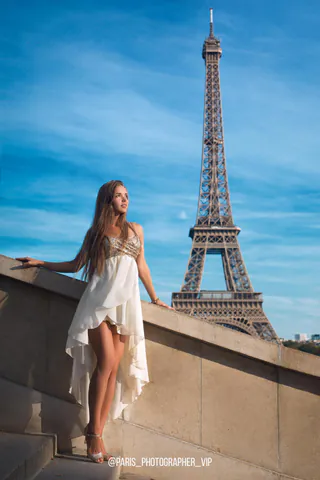
Trocadéro
The classic view, from the esplanade between the two wings of the Palais de Chaillot, straight across the Seine. The tower stands to the southeast, so in the late afternoon and evening the sun comes from behind you and lights it, while early morning gives soft, even light and a pale sky.
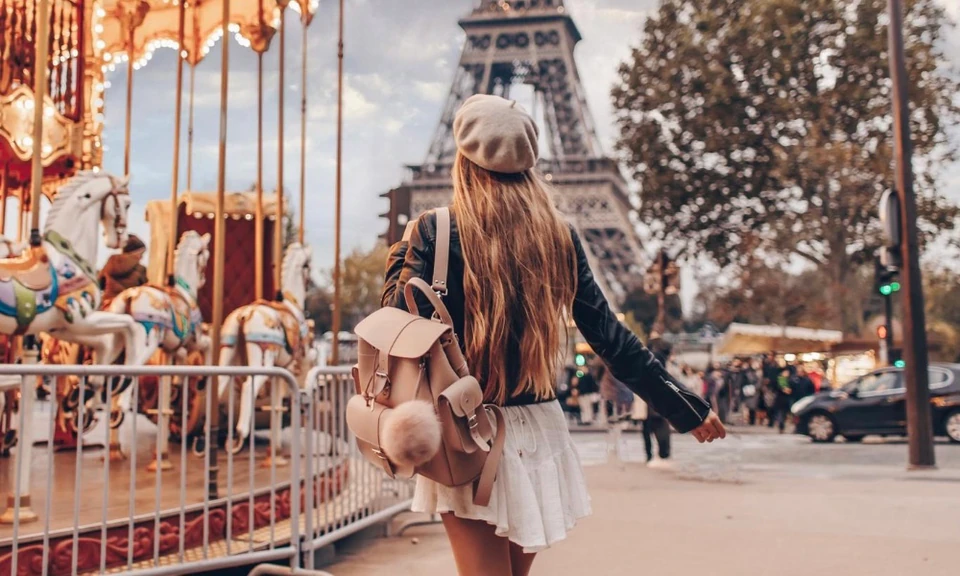
The problem is popularity. By mid-morning the esplanade is full, so the frame you see on Instagram usually comes from one of the first hours of the day. The carousel at the foot of the gardens is a lovely second background, and it is a short walk away.
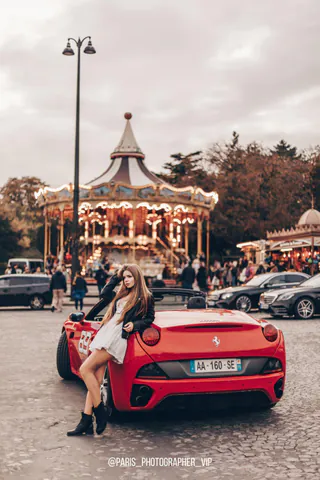
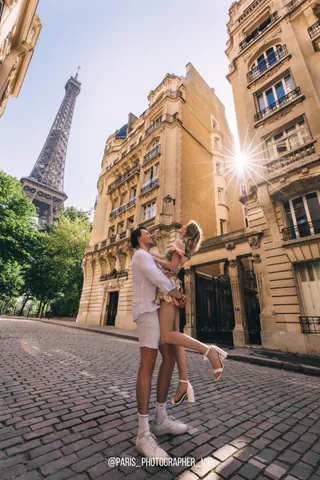
Rue de l’Université
The straight street with Haussmann buildings on both sides and the tower closing the view. It looks like a film set, but it is a normal street where people live and drive, so we stand on the pavement and watch for cars. Be quiet here in the early morning: there are bedrooms above you.
Pont de Bir-Hakeim
A two-level bridge with the metro running on top and a walkway under it, lined with steel columns. The columns make natural frames, and the shape repeats into the distance. Trains pass overhead on line 6, which adds some movement and noise, but on a photo only the movement stays.
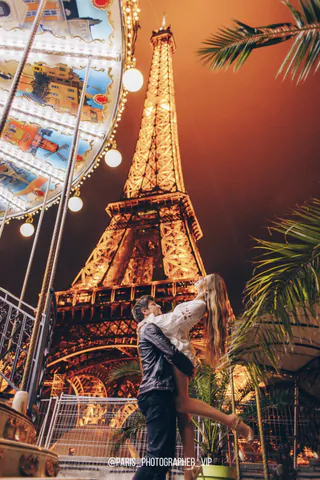
Champ de Mars
The long lawn south of the tower. It suits the blue hour and the night, when you can stand further back. The whole tower is lit in gold from nightfall and sparkles for five minutes on the hour, according to the tower’s own site. The lights go off around midnight, and the operator can change the schedule for events.
Pont Alexandre III
If we could keep only one bridge, it would be this one. It was built for the Universal Exhibition of 1900, and everything on it was made to impress: bronze lamps, garlands, gilded winged horses on the pillars at each end.
From the middle of the balustrade the Eiffel Tower appears far off down the Seine, small enough to fit behind a person without taking over the picture. The lamps also look good close up, as the frame below shows.
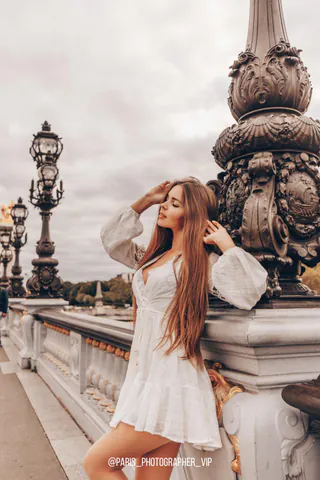
The bridge is exposed and has no shade at all, so harsh midday sun is the one thing to avoid. Any overcast day works in your favor: the stone and the bronze look richer under cloud than under blue sky.
The Louvre Pyramid and the Palais-Royal
The glass pyramid stands in the Cour Napoléon, and it photographs best when the sky is blue, because the glass picks up the color. Arrive early: once the museum opens, the courtyard fills up quickly.
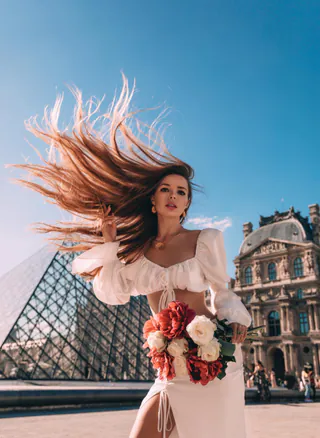
The museum’s own rules allow photos for personal use in its permanent collections but ban flash, lighting and selfie sticks, so a real photo session belongs outside.
A short walk north is the Palais-Royal, with the striped columns of Daniel Buren in its courtyard and arcades around a quiet garden. It is the place to go when the river is crowded and you want symmetry and calm. It is also home to government offices, so expect guards and closed gates in the evening.
The Arc de Triomphe
The arch stands in the middle of one of the busiest roundabouts in France. Do not cross the traffic: the way to the arch is a pedestrian underpass from the Champs-Élysées and from the Avenue de la Grande Armée.
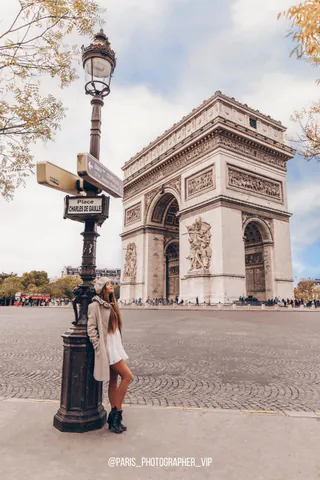
For a photo you often don’t need to go there at all. From the avenues around it the arch fills the end of the street, and an old street lamp makes a good foreground.
Palace hotels and the Golden Triangle
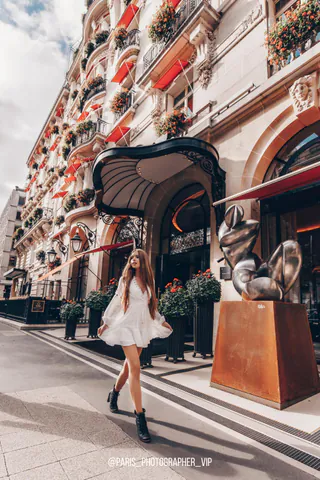
Avenue Montaigne, Avenue George V and the streets around them have the awnings, flower boxes and shop windows that make a picture feel expensive without any landmark in it. Stand on the public pavement, leave the entrance free, and ask the doorman if you would like to go further. Hotels decide about their own property.
Montmartre
Rue de l’Abreuvoir, with its pink house, and the stairways around Sacré-Cœur give you the village side of Paris. Weekdays are far easier than weekends, and sensible shoes matter more than anywhere else in the city: the slopes are steep and the paving is uneven.
When to shoot: sunrise and sunset by month
We calculated these for the middle of each month in central Paris, in local time. “Golden hour” here starts when the sun drops to 6° above the horizon and lasts until sunset. On the day, take it as a guide: it shifts by a few minutes a week.
| Month | Sunrise | Evening golden hour starts | Sunset |
|---|---|---|---|
| January | 8:39 | 16:29 | 17:21 |
| February | 7:59 | 17:25 | 18:10 |
| March | 7:04 | 18:13 | 18:55 |
| April | 7:00 | 19:59 | 20:41 |
| May | 6:09 | 20:38 | 21:25 |
| June | 5:46 | 21:05 | 21:55 |
| July | 6:02 | 21:01 | 21:49 |
| August | 6:42 | 20:22 | 21:06 |
| September | 7:26 | 19:22 | 20:04 |
| October | 8:10 | 18:18 | 19:01 |
| November | 7:58 | 16:21 | 17:10 |
| December | 8:37 | 15:58 | 16:54 |
Two things stand out. In June the sun rises at about a quarter to six and sets just before ten, so a morning session means a very early alarm and an evening one means a late dinner. In December, the whole day is short enough that morning and golden hour are only a few hours apart.
Rules worth knowing
- Drones. Leave yours at home. Leisure drones are not allowed over Paris.
- Crews and equipment. Filming permits on Paris streets come from the Préfecture de Police through the city’s film office, Paris Film, and requests must be filed 15 working days ahead. If your plan involves a big crew, lights or a closed-off street, raise it early.
- Other people. France protects people’s right to their own image, so we keep strangers out of the frame or retouch them.
Build a route, not a list
These places are spread across the city, and an hour lost in traffic is an hour of light gone. One good morning route might start at Trocadéro at sunrise, then cross to Rue de l’Université and Pont Alexandre III. An evening route might go from the Palais-Royal to the river for sunset. If you tell us your date and hotel, we’ll plan a route with you, and you can read about the vacation photoshoots we do across the city.